Women’s vulnerability in Europe: War, Migration and Poverty
A joint Declaration of the European Dominican Justice and Peace Commission
Preamble
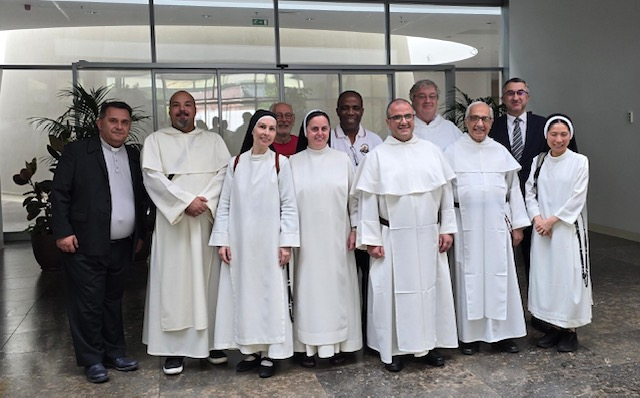
The European Dominican Justice and Peace Commission gathered in Zagreb, Croatia, for its Annual General Meeting from 8 to 12 June 2026. During the sessions, we discussed our reports and explored ways to address common challenges in the light of faith, striving to be true instruments of God’s love for those who suffer injustice in society. Several important issues emerged during our discussions. Nevertheless, we agreed to express our profound concern for women affected by war, forced migration, human trafficking, and poverty.
The joint declaration
Inspired by the Gospel, the Dominican commitment to Veritas, and Catholic Social Teaching, we affirm that wars, migration, human trafficking, and poverty are deeply interconnected and are often sustained by unjust economic structures that undermine human dignity and the common good.
In the Gospel, Christ identifies himself with the vulnerable: “I was hungry and you gave me food, I was a stranger and you welcomed me” (Mt 25:35). Every woman suffering from violence, displacement, exploitation, or deprivation bears the image of God and possesses an inalienable dignity that must be respected and protected.
Women continue to bear a disproportionate burden in situations of armed conflict. In Ukraine, displaced women experienced three times higher rates of gender-based violence than local residents, such as systematic use of rape, gang rape, forced nudity and sexual torture.1 Sexual violence is commonly used as a weapon of war in various armed conflicts around the world. Sixty-two percent reported violence within the home and one in five suffered violence from armed men.2 Women exposed to armed conflict also show two- to three-fold higher rates of anxiety, depression, and post-traumatic stress disorder.3 Moreover, women are very often left alone to care and provide for their families during and after the war. As Pope Francis reminds us in Fratelli Tutti, “every war leaves our world worse than it was before” (FT 261). We therefore call for the protection of women and girls, greater support for survivors of violence, and the meaningful participation of women in peacebuilding and post conflict reconstruction.
Migration is another major challenge of our time. Many women are compelled to leave their homes because of war, persecution, environmental degradation, and economic deprivation. Along migration routes and in destination countries, they often face exploitation, discrimination, and precarious labour conditions. Following the Church’s teaching that migrants are to be welcomed, protected, promoted, and integrated (FT129; Caritas in Veritate, 62), the Commission calls for policies that safeguard the dignity and rights of migrant and refugee women while addressing the conditions that force migration.
Poverty remains another major source of vulnerability. Across Europe, women continue to experience unequal wages, unequal access to employment, education, social protection, and economic resources. Among informal caregivers, 66% of women report being unable to meet unexpected expenses, compared with 34% of men.4
At the root of many of these challenges lies an economic system that too often elevates profit to the status of an idol, subordinating the dignity of the human person and the common good to the demands of the market. Indeed, Pope Francis warned that “this economy kills” (Evangelii Gaudium, 53), while Pope Leo XIV has likewise called for economic, technological, and political development that places the human person at its centre and strengthens social cohesion (Dilexi Te, 92-93).
Following Pope Leo XIV’s exhortation (DT 97), we commit ourselves, and encourage our brothers and sisters, to engage in both critical reflection and practical action aimed at identifying, promoting, and implementing alternative economic models that place the common good above profit and ensure that economic life serves all people, especially those who are most vulnerable. We call upon political leaders, economic actors, Church communities, and all people of goodwill to work together in the pursuit of justice and peace, so that everybody may live in freedom, security, dignity, and hope.
Fr Ivan Attard Maltese Province
Fr Günter Reitzi German-Austrian Province
Fr Rui Manuel Grácio Das Neves Portugese Province
Fr Drago Ferencek Croatian Province
Sr Philomena Benedict Le Gall Regional Promoter of Justice and Peace for Europe and the Middle East
1 Genocide Watch: https://www.genocidewatch.com/single-post/torture-and-rape-russia-s-weapon-of-war-in-ukraine
2 The Lancet Regional Health – Europe: https://doi.org/10.1016/j.lanepe.2022.100408.
3 The International Journal of Environmental Reasearch and Public health: https://doi.org/https://doi.org/10.3390/ijerph20042840.
418th European Public Health Conference 2025: https://doi.org/10.1093/eurpub/ckaf161.1121.
Single-parent households headed by women also face elevated risks of in-work poverty.
5 As Gaudium et Spes teaches, the goods of the earth are destined for all people (GS 69).